

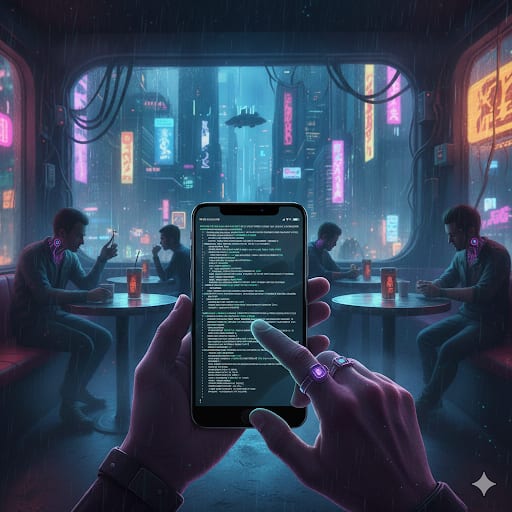
Imagine this: You wake up, get ready, jump on your bicycle/motorcycle, and head to your favorite café in the city center. You order your beloved cappuccino, find a comfortable spot, and instead of lugging out a heavy backpack, you simply slide your phone out of your pocket.
You open a terminal emulator. You tap git pull. You launch Claude Code.
You aren't squinting at tiny brackets or fighting with an on-screen keyboard to type complex syntax. Instead, you start typing prompts. "Implement the user authentication flow." "Refactor the database schema." "Fix the layout bug on the dashboard." You sip your coffee while the AI writes the implementation. You review it, approve it, and deploy it.
Sounds ridiculous? A few years ago, coding on a phone was a novelty act—a painful exercise in frustration reserved for emergencies. But today, with the rise of AI Agents, it is not only possible; it is a superpower. You don’t need to carry your laptop anymore to build things on the go.
From Typist to Architect
Why does this work now when it failed before? Because the nature of coding has changed.
For decades, programming was about syntax. It was about typing curly braces, semicolons, and exact variable names. Doing that on a glass screen is a nightmare. But today, programming is shifting toward intent. You are no longer the typist; you are the architect. Your job is to describe what you want, and the AI Agent handles the how. Mobile keyboards are terrible for code, but they are excellent for natural language. If you can text a friend, you can deploy a feature.
Coding on mobile phone was possible before, but AI took it to the next level
The "Found Time"
This shift unlocks a hidden asset we all have but rarely use: "Found Time."
- Commuting: That hour on the bus or train isn't just for doom-scrolling social media anymore. It’s a development sprint.
- The Queue: Waiting at the bank or the doctor's office? That’s 15 minutes to review a Pull Request or outline a new module.
- Domestic Downtime: Watching a movie with the family? You can casually tweak a UI component during the commercials.
It isn't about working 24/7; it's about freedom. It's about the ability to fix a bug while waiting for your order at a restaurant, rather than having to rush home to your desk.
The Experience
The modern mobile setup is surprisingly robust. As an Android user, I rely on tools like Termux to get a full Linux environment right in my pocket. I will be presenting the setup exclusively for Android—as that is my daily driver—but for those of you on iOS, rest assured that similar professional terminal tools exist for your platform as well.
With this setup, you can connect to your cloud instance, fire up your AI agent, and wield the same power as a desktop workstation. The friction is gone. The heavy lifting is done by the cloud and the AI. You are there to guide, review, and create.
Conclusion
We used to think of "mobile work" as checking emails. Now, it’s building products. The next time you leave the house, try leaving the laptop behind. You might find that the best development environment is the one that’s already in your pocket.
Check the next articles to learn more about the tools you can use to make this vision a reality.
Comments